Insight
The Case for Maritime AI: How Data is Rebuilding the Shipping Industry
Few technologies have changed the way businesses operate as fast as artificial intelligence (AI). Stanford University’s 2026 Artificial Intelligence Index Report states that AI adoption has outpaced that of the PC and the internet, and that based on its survey, organizational use averages 88% globally. From college student to Ph.D., startup to enterprise, the world has embraced AI technology faster than any major development in recent history.
The maritime industry is not immune from these trends. However, the regulatory-heavy sector tends to move more slowly than the technology around it—so AI presents a particular challenge when it comes to adoption. As of late 2025, research by Thetius indicates that only 33% of maritime operators have fully adopted AI beyond pilot projects.
AI has major implications in maritime when it comes to improving operational efficiency, safety and sustainability. But those improvements also come with the need for increased risk mitigation in cybersecurity, the challenges of adaptation in the workforce and regulatory implications that remain uncertain as the technology evolves.
Operational Efficiency
As AI makes its way into the shipping world, so has the advent of autonomous vessels that optimize fuel consumption and reduce human error. AI-driven tools can also reduce downtime and improve reliability through operational support.
Automating high-volume, repetitive tasks such as contract analysis, shift planning and compliance reporting adds consistency, accuracy and speed to many daily tasks. This frees up personnel to focus on higher-value tasks like shoreside decisions on fleet management and cost control or onboard operations and the wellbeing and safety of the crew.
But there are deeper uses for AI that connect it to other digital tools such as the Internet of Things (IoT) and digital twins, enabling AI algorithms to interpret local or cloud-based data from ship sensors to help operators predict potential failures and make proactive decisions. Monitoring risks or identifying problems before they occur saves critical downtime and cost by predicting when maintenance is or will be needed.
Good Data Makes Better AI
Pilot outcomes are also determined by data. An AI model can’t solve a problem for which there is incomplete, inaccurate or inaccessible data. Before pressing the greenlight on an AI pilot, it’s essential to understand the data requirements of the model and then undertake whatever data housekeeping is necessary to meet them.
In some instances, it may be that data sources are of poor quality or too fragmented for the pilot to proceed—far better to understand at the pilot stage than after the program is underway and delivering unreliable or inaccurate results. This particularly matters when it comes to an industry as strategic as shipping, where poorly informed decisions can escalate quickly with significant real-world impacts. With a recent study by Thetius finding 81% of surveyed maritime organizations have pilot programs underway, it’s clear the industry understands the criticality of integrating AI into operations.
The Special Case for Maritime AI
Training AI on high-quality data makes it essential for shipping companies to work with vendors who speak their language, understand their pain points and can identify the AI-friendly wins that will deliver quick ROI. The maritime and offshore industries face unique challenges and opportunities that “off the shelf” solutions simply can’t address.
The individual fingerprint of every ship’s unique patchwork of IT/OT systems and the fact that cloud-first, always-connected, subscription-based software often falters in environments with degraded connectivity makes experience of the utmost importance. Maritime technology experts recognize where AI can deliver actual wins that show up in real-world operations and affect the bottom line.
ABS Consulting helped one shipowner cut the costs and complexity of AIS monitoring across its fleet by integrating AIS feeds with company policies to deliver real-time tracking and automated anomaly alerts, reducing manual monitoring and accelerating detection and response. The result was lower costs and strengthened operational oversight and compliance with real-time anomaly alerts.
And when an OSV operator with more than 100 assets needed to clean and standardize critical systems spare-part data ahead of a migration to a new computerized maintenance management system (CMMS), ABS Consulting used AI to help extract, clean, map and import the fragmented data sets ranging from spreadsheets to paper logs. AI helped create a unified, accessible, spare parts taxonomy to support a clean, consistent migration, reducing the data cleanup effort and future maintenance complexity.
Scaling Success
From generative design and data visualization to more efficient energy systems and streamlined navigation of compliance issues, AI is transforming the maritime industry as operators move past the pilot phase.
In an industry where operational performance, safety and resilience are inseparable, where compliance and contractual complexity is a lived daily reality, and where unexpected hazards can occur at any time, AI mitigates risk. From design to sustainability, it uses data from its source to create predictive analytics, optimize maritime lifecycles, improve safety and reduce costs while maintaining regulatory compliance.
Advancing Operations with AI and Automation
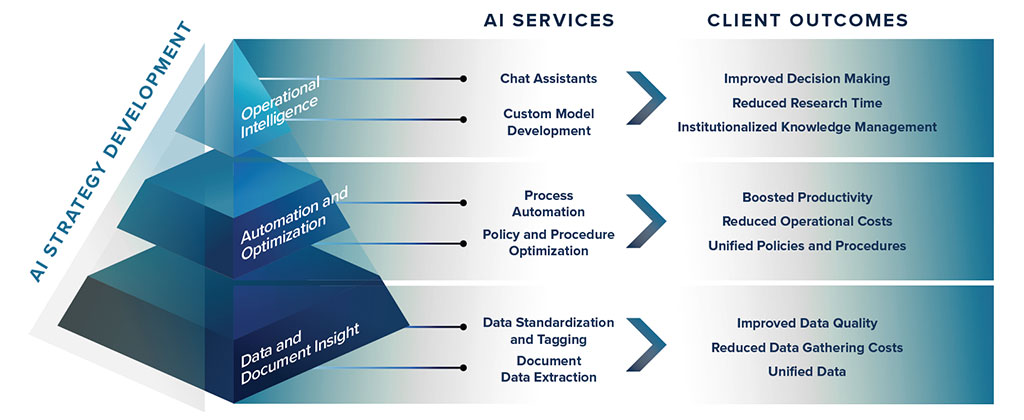
AI is transforming operations across all sectors, driving efficiency, innovation and enhancing decision-making. ABS Consulting's AI and Automation Services are tailored to meet you where you are, whether you are just starting out or seeking to take your AI solutions to the next level.
Complete the form below to connect with one of our AI experts.
Helping You Go Further, Faster
ABS Consulting's AI Consulting Services safely unlock the value of an organization's data with custom AI solutions tailored to assets and operations, helping organizations improve operational efficiency, enhance safety outcomes and reduce operational risk.